"This site requires JavaScript to work correctly"

Robotics, m.eng.

Faculty of Applied Natural Sciences & Industrial Engineering

Course Content

Shaping transformation: robots as part of everyday life

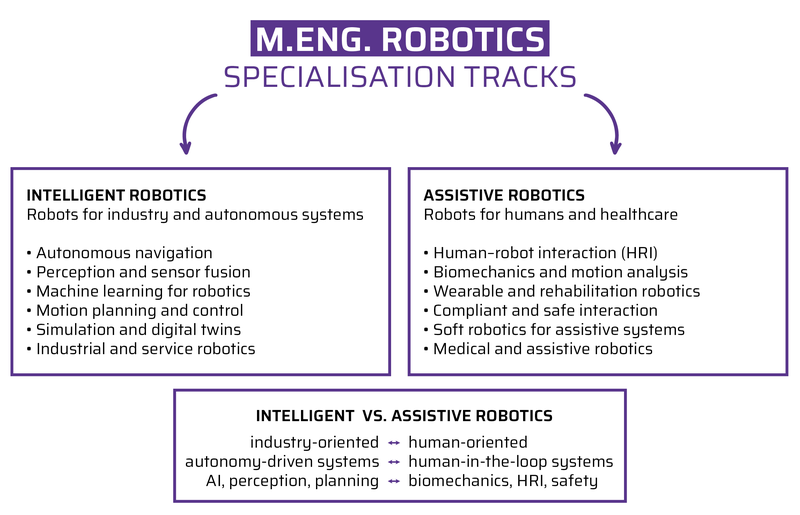
This postgraduate programme provides two different tracks to choose from: A) Intelligent Robotics and B) Assistive Robotics.The Master's degree programme Robotics will be based on the content of the Campus Cham - Intelligent Robotics and the requirements of regional companies and will include industrial and/or medical technology applications, for example. Graduates should be able to work both in research and development as well as in industrial applications.

The internationally oriented Master's degree programme enables students to deepen their knowledge and understanding of robotics in general and the use of AI in robotics in particular. By combining teaching content on robotics, systems engineering and human-robot interaction as well as machine learning and computer science, expert knowledge on the fundamental disciplines of intelligent robotics is imparted. In addition, students acquire specialist knowledge in the areas of perception in robotics, modern automatic control and decision-making systems (e.g. motion planning), robot modelling and simulation as well as on the application side in the field of industrial robotics and automation. This enables students to cope with the increased use of robotic systems in industry and to help shape this - from development and commissioning to application and interface analysis through to supporting end users.

Other key course content includes intelligent multi-agent systems and project-based case studies in the field of robot programming (ROS). Students acquire the necessary specialised knowledge, skills and methods to independently apply scientific findings and processes in industry and the service sector.

In addition, students acquire basic knowledge and skills in concepts, results and methods that correspond to the current state of science and allow them to familiarise themselves independently with further technical developments.

details & Downloads

At a glance

Degree

  • Master of Engineering (M.Eng.)

Duration

  • 3 semesters

ECTS points

  • 90

Start

  • Winter semester & summer semester

Location

Taught in 

  • English

Language requirements

  • If German is not your native language, proof of sufficient German skills is necessary.
  • If English is not your native language, proof of sufficient English skills is necessary.
  • The admission requirements are stipulated in the study and examination regulations (§3 Qualification for the programme, § 4 Proof of ECTS credits not yet obtained, § 5 Modules and proof of performance).
Details & Application

Application period

  • 15 April - 15 June (entry in October: winter semester)
  • 01 October - 01 December (entry in March: summer semester) 

Concerning all applications for either semester

  • Shortly after the respective application deadline, you will receive an invitation to the admission test. The test date specified in the invitation is fixed and cannot be changed, as the admission test is held promptly thereafter.

Admission requirements

  • Completion of an undergraduate study programme at a domestic or foreign university (minimum: 210 ECTS) credits in Robotics, Mechatronics or another related study course or a degree equivalent to such a university degree. Based on the documents submitted, the DIT examination board decides on the equivalence of degrees.
  • Additionally, an admission test may be required. This written exam covers key subjects at Bachelor’s level, including mathematics, physics, electronics & electrical engineering, systems theory, control engineering, computer science, robotics, and autonomous systems It is offered both online and on-campus in Cham, ultimately determining your admission to the programme.
  • Applicants having obtained their academic training (e.g., undergraduate degree) in non-member states of the Lisbon convention are recommended - though not required - to submit a GATE or GRE score report as well as a recognized German language certificate (overview of accepted certificates)  to further substantiate their application. Only test-centre versions - no Home Editions - will be taken into account.

Fees

  • No tuition fees, only student union fee
  • International students from non-EU/EEA countries are required to pay service fees for each semester. Click here to read about our service fees.
Links & Contact

Quicklinks

Counselling & Contact

Featurette Image

CAMPUS CHAM

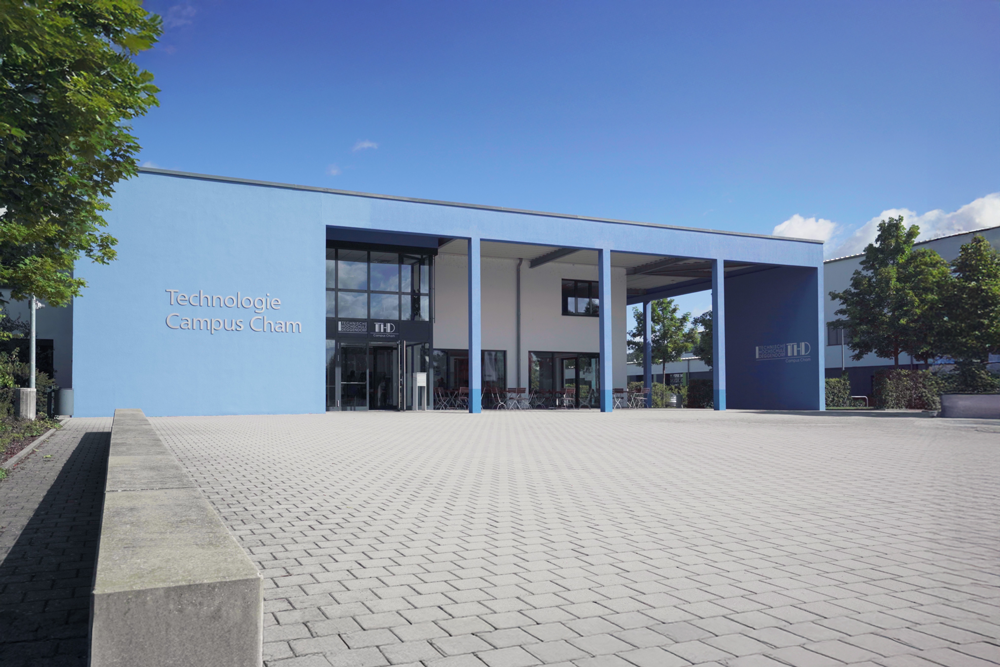
The Cham Teaching and Research Campus offers an international atmosphere, forward-looking degree programmes and cutting-edge research in mechatronics, robotics and AI. Here, theory meets practice – for the region’s economy and your future career! A subject-specific and application-oriented environment for highly innovative training programmes is provided by the Campus for Intelligent Production, the Campus for Intelligent Robotics and the Digital Start-up Centre (focus: digital production) – all of which are also based on Campus Cham.

Specialisation tracks

At the application stage, you can choose one of two specialisations. This allows you to tailor your studies to your individual interests and specialise for your future career.


Subject Overview

Overview of the courses, SWS (semester hours per week) and ECTS (European Credit Transfer and Accumulation System) in the Master's degree programme "Robotics":

1. Semester SWS ECTS
Robot Dynamics 4 5
Advanced Methods in Control Engineering 4 5
Statistics and Machine Learning for Computer Vision 4 5
Technical Project Management 4 5
Embedded Systems 4 5
Cross-Cultural Development for Engineers 4 5
2. Semester (Specialisation: Intelligent Robotics or Assistive Robotics) SWS ECTS
Specialisation: Intelligent Robotics
Advanced Methods in Robotics 4 5
Image-Processing and Computer Vision 4 5
Robot-Modelling & Simulation 4 5
Industrial Robotics & Automation 4 5
Case Study ROS Robot Programming 4 5
Intelligent Multi-Agent Systems 4 5
Specialisation: Assistive Robotics
Soft Robotics 4 5
Sensor Fusion and Perception for Assistive Robotics 4 5
Biomechanics 4 5
Rehabilitation Robotics 4 5
Case Study Assistive Robotics for Improvement of Life Quality 4 5
Human-Robot Interaction 4 5
3. Semester SWS ECTS
Subject-Related Elective Course (FWP) 4 5
Master's Module: - 25
Master's Thesis - 20
Master's Seminar (two parts: Master's colloquium (2 ECTS) and seminar series "Career Start into German Technology Companies") 2 5
Smartphone drehen um diese Inhalte anzuzeigen

Career Prospects

The programme equips students for scientifically grounded engineering roles in areas such as:

  • Development, construction and application of robots in various fields of application, for example production and medical technology
  • Development, construction and application of complex robot systems in the production environment
  • Leading and managing technical projects
  • Research and teaching

Attention is paid to a wide-ranging, qualified and scientifically sound education, which enables graduates to work in a variety of professions. Career opportunities are available not only in commercial and industrial companies but also in research and teaching as well as in the private sector.